What is Forest Bathing?
How a Japanese phenomena can inform our understanding of nature immersion and land justice
RELATIONSHIPSMENTAL HEALTHNEWSNATUREFORAGING
Cole Huang
7/24/20265 min read
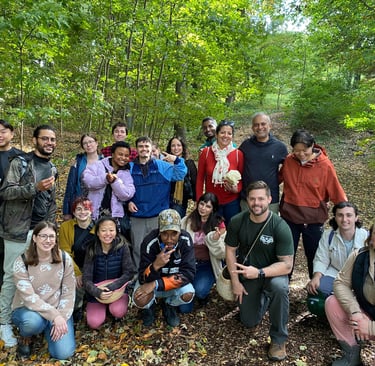
In 2024 I started on a journey of becoming a nature therapy guide and organizing nature immersion. This immersion, known as forest bathing (or Shinrin-yoku 森林浴), raises fascinating questions about our relationship to nature herself and land.
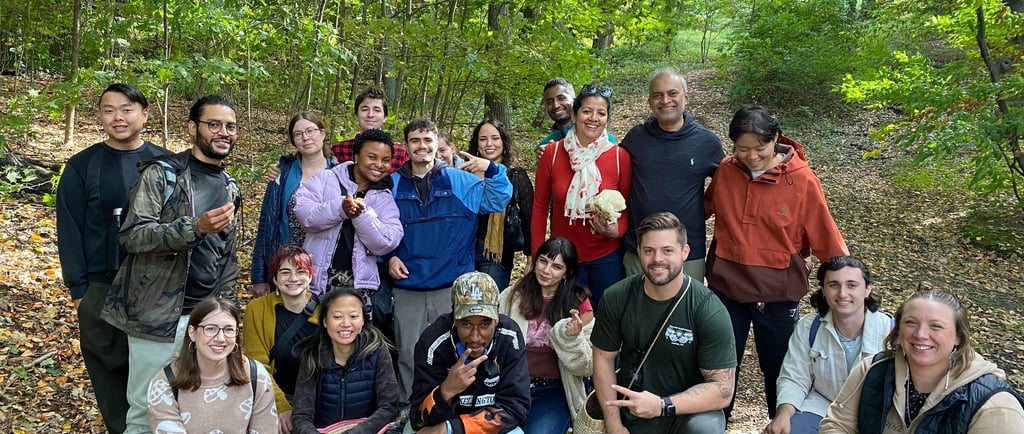
This May, I was excited to co-lead an event with Bay Staters for Creative Well-Being with herbalist Kanaya Ryland. We gathered in Franklin Park to experience the natural sounds and sensations of being in the forest with a grounding nature meditation.
As we wandered, we also learned about the mushroom and plant species that we found and their medicinal uses. Given that Bay Staters focuses on holistic health, nature education, and plant medicine, collaborating with Bay Staters has been an ideal opportunity. I also enjoyed the chance to offer a nature therapy meditation on one of the mushroom walks that Bay Staters offers and I highly encourage visiting the events page on their website to learn more about upcoming mushroom walks, gatherings and festivities.
As a nature therapy guide, I can say that taking a walk to explore the wonderful world of fungi and plants is more than just enjoyable—scientific research shows that spending time outdoors offers numerous physical and mental health benefits.
The first time I experienced forest bathing and these benefits I was in a difficult period of my life due to burnout from a job, and I had recently taken medical leave. On that day in early May, I attended an event offered by a forest bathing guide at a beach south of Boston called Webb Memorial State Park. I arrived flustered, very late, and was greeted enthusiastically by Tam Willey of Toadstool Walks, a guide who eventually became my mentor.
As I settled into the experience I felt like I had entered a portal into another world. When I closed my eyes and meditated, I remember the unique experience of leaning into the sensations around me as a form of meditation- the sound of the waves, the cry of seagulls, the way that the leaves were rustling, and the smell of the salty ocean air. As someone who has difficulty with seated indoor meditation, I was already captivated by this new practice.
As we wandered around the beach to explore our natural surroundings, I distinctly remember looking across the water at the Boston skyline. I felt like I was in another realm from that place and that the land colonially known as Boston looked like a human-made nest of metal, stone, and artificial materials all powered by fossil fuels. I looked around me at the beach and thought of how everything around me had not been placed here- it simply was here.
Forest bathing is, as it is worth repeating, immersing yourself in a forest setting and having an intentional, mindful, sensory experience of being outdoors in nature. In the 1980s, Japanese society was going through a transition to a more tech-based economy and people were spending less time outdoors, and the rates of chronic illnesses began to increase drastically. Forest bathing emerged as a concept promoted by the Japanese government alongside a body of scientific research about the health benefits of time spent in nature. Many early forest bathing experiences in Japan involved measuring heart rate and taking samples of saliva to measure cortisol.
As I guide events, I notice that my participants enjoy the experience of reconnecting with the sensory experience of nature, such as noticing the texture of the earth, the many colors of lichen present on the trunk of one tree, or remembering that clouds are passing above us and noticing their delightful shapes. I also notice that the experience becomes co-created in a beautiful way because my participants each share their experiences out loud to the group. I personally believe that slowing down enough to simply attentively observe nature is an interesting contrast to quickly hiking through it, taking photos, or identifying birds. It can open up a sense of interconnectedness with the beings around you.
I find it interesting that a practice that emerged as so specifically scientific in Japan has been marketed in the US as specifically spiritual and is strongly associated with the perception of Japanese culture as peaceful and relaxing. However, it makes sense. Shinto, an ancestral Japanese religion, values the animacy of nature. Within the collective consciousness of Japan in the 1980s, a sense of spirituality surrounding trees and nature was more of a given emerging from that context and I imagine it didn’t need to be marketed to the Japanese public.
In contrast, in the United States the colonization of this land has been based on the idea of conquering and subduing an inanimate nature, and most US residents are settlers and descendants of settlers. Therefore, one of the realities I have noticed as a forest bathing guide trained by a US-based forest bathing organization is a specific agenda of creating a container where spiritual experiences can re-emerge and allowing people to come to a remembering of the animacy of nature, so they can find it through actual direct contact with nature.
The beautiful trees and wildlife that my participants engage with at my events are always owned by colonial institutions and land owners. Japan is a land that has been continuously inhabited by people who are ethnically Japanese and has never been colonized by European powers. In contrast, in the US, simply reconnecting with and enjoying nature without acknowledging the history of this land is problematic. I organize events on unceded land that is ancestral to the Massachusett, Wampanoag, Pawtucket and Nipmuc people. I strongly believe that for those of us who aren’t Indigenous, finding a spiritual connection with the nature that is present here today needs to be accompanied by clear and direct efforts towards Indigenous solidarity.
If you love nature I encourage you to build Indigenous solidarity into your life as a monthly or annual routine in some way. One of the best ways you can do this is by becoming a monthly donor to an Indigenous-led organization such as North American Indian Center of Boston or Massachusetts Center for Native American Awareness. Any amount monthly makes a huge difference because it increases the operating budget of the organization. When you think about it, if 10 people are giving $10 /monthly donations that increases the budget of the organization by $100 a month to do things like purchase critical supplies that weren’t funded by a grant, and in these times receiving grant funding has become much more difficult for these organizations.
Other ways of supporting are annually attending an event, such as the Thanksgiving Day of Mourning, calling your legislators every Indigenous People’s day about the Indigenous Legislative Agenda, or attending the Cultural Survival Bazaar. Also you can support by sharing posts, and if you do this I encourage you to “share local.” So if NAICOB is having an event, share their event flyer post - even if that post isn’t a viral video, it is locally impactful to share it. I encourage you to take action and do just one of these things right now, even if it is sharing one post, adding a reminder to your calendar, registering for an event, or a one-time donation to one of these incredible Nipmuc food sovereignty projects. Taking steps like this builds momentum in this movement.
Thank you for taking the time to read my article and feel free to follow me on Instagram @nature.with.cole to stay connected.